FIELDNOTES·6 MAY 2026·3 MIN READ
Multi-Agent Orchestration & Vendor-Neutral Fields
When machines negotiate: managing the multi-vendor autonomous field
 Lena Software editorial team
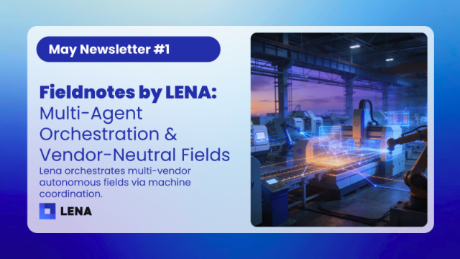
Industrial leaders are abandoning isolated automation to embrace a new era of multi-agent collaboration across global sites. The era of the “siloed machine” is officially over.
Systems must now negotiate resources and priorities before an intervention occurs within high-stakes industrial environments. Orchestrating these interactions is the new baseline.
Passive monitoring is replaced by active machine-to-machine negotiation protocols. Organisations are building a resilient immunity against proprietary locks now. Decision-making cycles occur in milliseconds.
When machines negotiate: managing the multi-vendor autonomous field
Industrial environments have evolved into complex digital ecosystems where different machine species interact through autonomous logic. Silos are dead.
Managing a vendor-neutral field requires a sophisticated understanding of how autonomous agents from multiple manufacturers communicate across shared networks. Gartner predicts that agent-to-agent interactions will soon define the majority of high-value industrial transactions across global value chains.
Every independent node within a smart site acts as a sovereign representative that negotiates for power, data bandwidth, and physical priority. Orchestrating these diverse agentic entities ensures that a single brand’s failure does not lead to a total systemic collapse during peak hours.
Technical leaders are focusing on agent engine optimisation to ensure that their proprietary logic remains compatible with universal industrial communication standards. The era of the multi-vendor autonomous field is here to stay. Success depends on the quality of digital diplomacy between machines.
The convergence of agentic AI and open standards
Industrial facilities are moving beyond fragmented automation to reach a state of total architectural convergence in 2026. Interoperability is the new baseline for success.
Johnson Controls predicts that open standards will become a foundational requirement for all large-scale infrastructure portfolios this year. Proprietary silos are officially dissolving.
The shift from providing passive insights to automating operational decisions marks the arrival of agentic AI within the industrial frontline. Systems now possess the intelligence to act independently:
- Dynamic control optimisation based on real-time environmental signals.
- Automated resource allocation across distributed and legacy assets.
- Seamless data rationalisation through unified open-standard platforms.
The convergence of facilities and IT teams is essential to tackle the growing complexity of cybersecurity threats in connected environments. Security is a shared responsibility today.
Strategic growth depends on the ability to turn facility data into a narrative of operational excellence and decarbonisation. Every saved watt supports future expansion. Success in 2026 belongs to organisations that embrace open ecosystems and intelligent building responses.
The era of negotiating industrial assets
The transition toward software-defined manufacturing has reached a critical inflection point where physical assets now manage their own operational logic. Static scheduling is over.
Siemens reports that autonomous production cells are increasingly utilising agentic protocols to negotiate task priorities across distributed factory floors. Integrating multi-agent systems allows disparate hardware to collaborate without the need for constant reconfiguration by human engineers during shifts.
Decentralised decision-making reduces the risk of a single point of failure within high-speed production environments. Every machine acts as an intelligent stakeholder:
- Real-time negotiation for energy consumption between heavy machinery.
- Autonomous task handovers between robots from different manufacturers.
- Self-optimising logistical paths for autonomous mobile robots on-site.
Strategic resilience depends on building an ecosystem where hardware remains agnostic to the underlying control software. Compatibility is the primary driver of growth.
The convergence of PLM and CRM in the aftermarket ecosystem
The boundary between product engineering and customer relationship management is officially dissolving at Hannover Messe 2026. Siemens and Salesforce are demonstrating a transformative partnership that connects Teamcenter PLM with CRM to redefine aftermarket business success.
Unlocking the full potential of asset monetisation requires a seamless flow of data between original design specifications and real-world customer interactions. Service excellence in the digital age depends on arming technicians with a complete digital twin, including maintenance records and potential failure modes.
Customers can now engage with AI agents within dedicated portals to resolve complex product issues using interactive 3D visuals and real-time data. Integrating product configurator capabilities with customer-specific needs reduces lead times while increasing recurring revenue across distributed portfolios.
The future of the aftermarket sector is officially connected, intelligent, and centred on the synergy between machines and humans.
LENA’S TAKE
Lena Software orchestrates diverse machine ecosystems to ensure seamless collaboration across every field site today. We provide the unified logic needed to bridge proprietary gaps between competing vendors.
Our platform harmonises signals from different vendors into a single operational truth. This proactive layer protects the bottom line while securing asset safety. Strategic success requires resolving clashing data streams instantly — we deliver the architectural anchor for autonomous fields.
Technicians utilise our logic to oversee autonomous machine negotiations. Success is officially orchestrated and reliable for your entire enterprise.
Fieldnotes lands monthly. Subscribe to get the next issue as it publishes.
Subscribe on LinkedIn