FIELDNOTES·7 JULY 2026·4 MIN READ
Field Tech in Oil & Gas
How field technology helps the oil and gas industry make faster decisions
 Lena Software editorial team
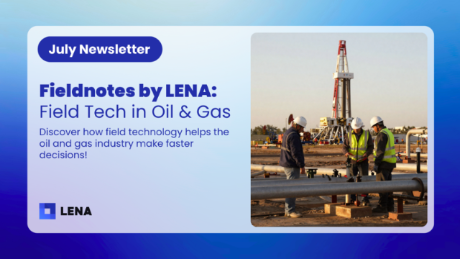
When people think about the oil and gas industry, they often picture billion-dollar investments, offshore platforms, massive pipelines, and sprawling refinery complexes.
Those assets certainly define the scale of the industry. But they don’t determine its daily performance.
Every day, thousands of operational decisions are made across service stations, terminals, pipelines, distribution networks, and production facilities. Individually, they may seem routine. Collectively, they shape profitability, compliance, operational continuity, and safety.
- Can this permit be approved?
- Has this inspection been completed correctly?
- Should this asset remain operational until the next maintenance window?
- Is this contractor authorised to continue work?
- Has every required photo, checklist, and signature been captured before the job is closed?
These aren’t strategic boardroom decisions. They’re field decisions.
Yet every one of them influences financial outcomes. A delayed inspection can postpone maintenance. An incomplete work order can delay invoicing. Missing documentation can complicate compliance reviews. A small operational oversight can quickly become a costly business issue.
In today’s oil and gas industry, operational excellence depends less on how quickly work is completed and more on how confidently decisions can be made. That confidence comes from one thing: trusted field data.
The most expensive delay is decision latency
Every hour, oil and gas operations generate thousands of data points across inspections, maintenance activities, permit approvals, contractor visits, HSE observations, environmental checks, and asset readings.
The challenge isn’t collecting that information. It’s ensuring it’s available before the next operational decision has to be made.
The gap between what’s stored in a document management system and what’s accessible at the point of work remains dangerously wide.
The consequences extend well beyond administration. When field information remains trapped in paper forms, spreadsheets, emails, or disconnected systems, supervisors wait for updates, operations teams reconcile conflicting records, finance delays invoice validation, and compliance teams spend valuable time searching for missing documentation instead of assessing performance.
The industry is increasingly recognising that loss of visibility can be just as disruptive as equipment failure. Following the Colonial Pipeline cyber incident, pipeline operations remained halted not because physical damage had been confirmed, but because operators could not immediately verify the true state of field assets. Operational certainty had to be restored before production could safely continue.
Recent research also identifies weak real-time visibility and fragmented digital systems as persistent causes of operational downtime across remote oil and gas assets, delaying response times and reducing reliability even when organisations have already invested in modern technologies.
Every delay introduces uncertainty. And uncertainty carries a cost. In an industry where assets operate continuously and every hour matters, delayed information behaves much like operational downtime. It slows approvals, extends maintenance cycles, increases administrative effort, and reduces confidence in every decision that follows.
Connected operations are becoming the industry standard
The oil and gas industry’s technology priorities are changing. Recent research shows operators are accelerating investment in AI-powered software, Industrial Internet of Things (IIoT), digital twins, and connected operational platforms.
According to ISG Research, the common driver isn’t technology for its own sake — it’s the need for better operational visibility, faster decision-making, and more integrated workflows across increasingly complex assets and workforces.
→A predictive maintenance model is only as accurate as the inspection data it receives.
→An AI scheduling engine is only as effective as the work orders feeding it.
→A digital twin reflects reality only when field updates are captured consistently and immediately.
In other words, digital transformation doesn’t begin with artificial intelligence. It begins with trustworthy field execution.
As organisations modernise their operations, the real competitive advantage isn’t collecting more information. It’s ensuring every inspection, maintenance activity, contractor visit, and safety observation is immediately available to everyone who depends on it.
Field technology has become decision technology
Field technology has evolved far beyond digitising work orders or replacing paper checklists. In modern oil and gas operations, it has become the operational layer that connects field execution with planning, compliance, procurement, and financial oversight.
This shift is particularly important in an industry where assets rarely operate in isolation. A single maintenance activity may involve internal engineers, external contractors, HSE teams, procurement specialists, and regional managers before work is completed.
Without a shared operational platform, every handover introduces delays, duplicate work, and opportunities for information to be lost or interpreted differently.
Modern field platforms reduce this operational friction by standardising how work is planned, executed, documented, and reviewed. Inspection results automatically feed maintenance planning. Contractor activities become traceable against service agreements. Permit approvals are linked directly to field activities, while complete audit trails are created as work progresses rather than reconstructed afterwards.
This level of operational consistency produces measurable business value. Teams spend less time coordinating between disconnected systems, managers gain a clearer view of work in progress across multiple sites, and leadership can make planning decisions based on current operational conditions instead of historical reports.
As assets become more connected and field operations more complex, the organisations that scale successfully will be those that standardise not only how work is performed, but how every operational decision is supported.
LENA’S TAKE
Digital transformation in oil and gas is often discussed through technologies like AI, digital twins, or predictive analytics. While these innovations are reshaping the industry, they all depend on something much simpler: reliable field data.
Every inspection, maintenance activity, permit approval, and safety check contributes to the quality of operational decisions. The faster that information moves from the field to the people who need it, the faster organisations can respond, adapt, and improve.
At Lena Software, we believe the future of field operations isn’t just about managing work more efficiently. It’s about giving every team the visibility to make better decisions, every single day.
Fieldnotes lands monthly. Subscribe to get the next issue as it publishes.
Subscribe on LinkedIn