FIELDNOTES·13 MARCH 2026·4 MIN READ
The Silent Weight of the “Execute” Button
As tort liability migrates from code to the frontline, who actually owns a decision in 2026?
 Lena Software editorial team
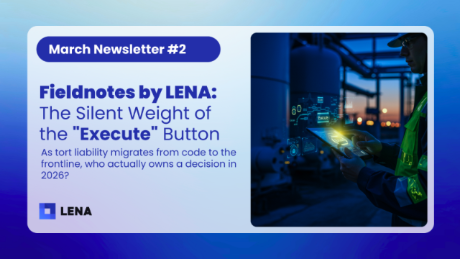
This month we are exploring the silent weight of the “Execute” button.
Field technicians today arrive at sites guided by algorithms that have already predicted the fault, mapped the route, and selected the tools. While these systems offer a level of precision previously impossible to achieve, they also introduce a fundamental tension between machine suggestion and human responsibility.
2026 marks the year where the novelty of autonomous assistance has been replaced by the gravity of operational liability.
Organisations once viewed artificial intelligence as a co-pilot that lived safely behind a screen. The issue is not only technical accuracy. It is operational liability.
- Systems operate with increasing independence across the field.
- Legal and ethical requirements for human intervention have paradoxically increased.
- Decision-making speed is outpacing traditional governance frameworks.
The technician is no longer just a solver of mechanical problems. They have become the final arbiter of a digital logic they did not write but are legally bound to oversee. The strategic question is no longer whether work was completed, but whether field execution is structured to support human judgment or if it merely feeds a dashboard at the cost of clarity.
Migration toward legal responsibility: the ownership of decisions
Regulatory changes in January 2026 emphasise that the burden of proof rests on the enterprise user. Legal frameworks now identify the organisation as the primary liable party when an autonomous system fails during critical field interventions, making the identification of the decision-maker a vital operational priority for leadership.
Contractual agreements are evolving to exclude standard warranty claims for errors caused by algorithms. Insurance providers now demand verifiable logs showing human oversight before covering any industrial incident, as the era of blind trust in technology officially ends.
- Tort liability is migrating from software developers toward the entities managing daily application.
- Human operators must validate machine suggestions to maintain an active legal defence.
- Verifiable logs of every decision path have become mandatory for all high-risk interventions.
Establishing a clear chain of command ensures that technical staff can explain the logic behind automated actions. This transition from rapid innovation to strict compliance protects the workforce while maintaining operational integrity during complex repairs.
Autonomous decision networks: the rise of multiagent systems
Autonomous agents are moving from being tools used by humans to being team members that negotiate and execute tasks independently. These systems automate complex processes and reduce risk by enabling decentralised entities to coordinate decisions continuously rather than waiting for sequential human input during high-stakes field operations.
Multiagent systems allow intelligence to operate across distributed environments, mirroring the physical reality of modern field assets. Managers gain efficiency through real-time coordination, yet agent negotiation speed creates a governance gap requiring constant behaviour monitoring.
- Agentic systems require a master governance layer to prevent cascading errors across distributed field teams.
- Real-time monitoring of agent behaviour has become as important as monitoring the health of physical assets.
- Decentralised decision-making reduces operational latency but demands a verifiable audit trail for every machine-led interaction.
Maintaining visibility over these autonomous networks ensures that technical teams retain control over the broader operational intent. Automated coordination provides a competitive advantage, but the lack of human-centric oversight can lead to systemic failures if the logic of individual agents remains unchecked.
Regulatory milestones: the legal mandate for human oversight
The European Union Artificial Intelligence Act establishes a definitive timeline for industrial sectors to implement traceable governance. Organisations operating within critical infrastructure are legally required to ensure that every machine-led decision remains subject to meaningful human intervention.
Maintaining compliance requires field technicians to actively validate algorithmic outputs instead of passively following automated instructions. Transparency becomes a structural necessity when high-risk systems generate work orders that impact environmental safety or public well-being.
- Personnel must have the authority to override autonomous suggestions without fear of facing operational reprisal.
- Systems are required to generate exhaustive audit trails for every decision path taken during high-risk activities.
- Technical descriptions of AI logic must be accessible to non-expert staff responsible for overseeing the technology.
- Continuous monitoring ensures that automated behaviour does not deviate from established safety and legal standards.
Compliance shifts from an administrative burden into a core operational requirement as the August 2026 milestone nears. Every digital interaction on the frontline serves as a legal record, protecting the organisation from liability while ensuring that the technician remains the primary authority over the machine’s actions.
LENA’S TAKE
Accountability in the field is a fundamental design requirement rather than a legal hurdle.
Digital systems must support human intuition instead of overriding it with unverified logic. Fragmented data and untraceable decisions are not just workflow hiccups; they are significant liability risks.
Organisations using Lena Software create a verifiable record of truth that protects their people and their assets. Providing operational clarity means ensuring that when a decision is made, the “why” is just as visible as the “what”. Operational excellence is achieved by empowering the human to lead the loop rather than removing them from it.
Fieldnotes lands monthly. Subscribe to get the next issue as it publishes.
Subscribe on LinkedIn