FIELDNOTES·5 AUGUST 2025·3 MIN READ
Safety, Powered by AI
AI-driven systems are transforming risk into real-time resilience
 Lena Software editorial team
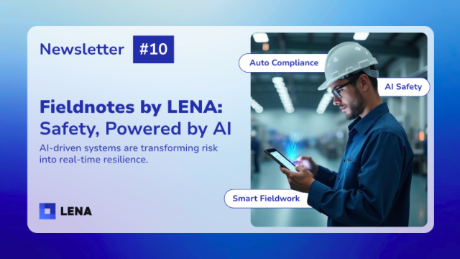
Let’s be honest, most fieldwork still runs on duct tape and good luck. And in complex environments such as fire hazard zones, high-voltage sites, chemical exposure fields, that’s not just inefficient, it’s dangerous.
You’d think in 2025 we’d have moved past clipboards and crossed fingers, but here we are. The numbers don’t lie: 2.78 million work-related deaths each year globally, many in sectors where visibility, coordination, and response time should be the first priority, not an afterthought.
This edition examines how data-driven strategies, AI-powered monitoring, and automated compliance are transforming field service in some of the most challenging environments.
One officer for every 70,000 workers: can we really keep up?
Federal OSHA oversaw the safety of more than 130 million workers with just 1,850 inspectors. That’s one compliance officer per 70,000 workers, an impossible ratio in industries where even a moment’s delay can be fatal.
While inspections remain steady, fatalities haven’t budged significantly — 5,283 in the last year alone. And the top violations? Falls, hazardous energy, and respiratory risk are problems tied directly to reactive rather than real-time intervention.
Experts encourage AI-powered field service for complex environments
Recent research reveals a clear trend: organisations using AI-enhanced field service report up to 50% fewer unplanned equipment failures and a 30–40% reduction in downtime. Predictive analytics and optimised technician deployment are shifting maintenance from reactive fire-fighting to proactive risk management.
However, experts caution that embracing these tools requires a cultural shift toward data-driven operations, a transition that is still underway in many sectors.
Automated compliance might be the missing link
As complex environments grow in scale and regulation tightens, experts argue that intelligent real-time surveillance combined with automated workflow enforcement is critical.
Recent industry surveys show that facilities deploying AI-powered monitoring reduce preventable injuries by over 20%, while digital credentialing cuts compliance violations by nearly one-third. Together, these innovations form the backbone of a safety-first approach that prevents human error and ensures accountability in high-risk fieldwork.
Live from London: how surveillance tech is making its way towards the field
In a recent pilot at one of the busiest stations on the London Underground, Transport for London tested an AI-powered computer vision system capable of detecting unsafe behaviour — aggression, weapons, fare evasion, and even people falling onto the tracks. The system analysed live CCTV footage, scanning body language and movements in real time to prevent harm before it escalated.
What this test reveals is not just the potential for safer public transit, it signals a shift. If surveillance can respond to danger in milliseconds underground, what could it do above ground, in fire-risk zones, energy plants, remote facilities?
- It flags the technician in distress before someone needs to make a call.
- It tracks risky flows of personnel in secure zones.
- It ensures no gate is passed without accreditation.
- And in places where human eyes can’t be everywhere, it scales presence with precision.
AI can already predict fatigue — what happens when you add field intelligence?
AI-powered fatigue monitoring is no longer speculative; it’s happening. A recent review of over 50 scientific studies confirms that wearable technologies, when paired with advanced AI, can detect early signs of worker exhaustion by analysing physiological data like ECG and EEG.
Through multi-modal signal analysis and data fusion techniques, they identify when a worker is nearing the edge, helping prevent lapses in attention, reaction time, or physical performance before they pose a risk.
But here’s the bigger picture: what if this real-time insight is not an isolated tool, but part of an intelligent field ecosystem? Fatigue-related incidents remain one of the leading causes of injury in high-pressure fields. With the proper integration of preventive technologies, field operations can move from reactive to responsive, and ultimately, to preventive.
LENA’S TAKE
What all this tells us is simple: technology, especially AI, isn’t just a back-office upgrade.
It belongs everywhere, from tunnels and towers to control rooms and construction zones. And when it’s paired with smart field systems, it does more than make things efficient. It makes them safer, smarter, and more human-aware. In complex environments, this kind of intelligence isn’t a luxury; it’s essential.
Fieldnotes lands monthly. Subscribe to get the next issue as it publishes.
Subscribe on LinkedIn