FIELDNOTES·16 JANUARY 2026·5 MIN READ
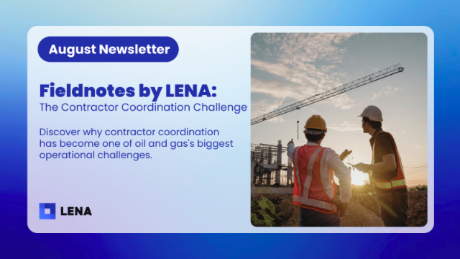
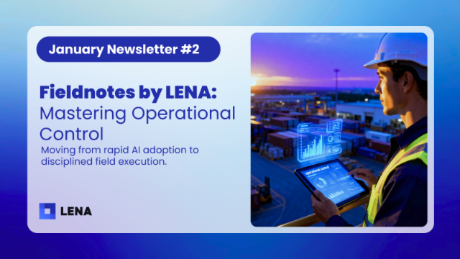
Mastering Operational Control
Moving from rapid AI adoption to disciplined field execution
 Lena Software editorial team
We didn’t just leave 2025 behind. We tested ourselves in it.
For many organisations, last year felt like a long experiment, a test lab where new tools were tried, new systems were layered on, and new promises were made. Some teams rushed into AI and automation, eager not to miss the next wave. Others moved carefully, piloting quietly. And some simply watched, waiting for clarity.
Now, a few weeks into 2026, that clarity is finally arriving. Because one thing is becoming impossible to ignore: trying new technology is no longer enough.
The real question shaping this year isn’t how fast we can adopt tools. It’s something more uncomfortable: do we actually have control over our operations?
When complexity becomes the default
Operations have never been simple, but today, complexity is the baseline. Multiple digital systems. Endless data streams. Hybrid work. New compliance pressures. New risks appearing faster than teams can react. In this environment, speed without control doesn’t create an advantage. It creates fragility.
That’s why 2026 is quietly becoming something else. Not just a year of innovation — a year of operational discipline.
Winning uncertainty with discipline
As 2026 begins, Harvard Business Review offers a quiet but timely reminder: in periods of sustained uncertainty, progress rarely comes from bold moves. It comes from discipline.
The risks ahead aren’t sudden shocks. They’re slow drifts, creeping cost increases, delayed tariff impacts, AI speeding execution while adding coordination risk. These pressures accumulate, often unnoticed, until control starts to slip.
HBR’s 2026 outlook points to a clear pattern. The strongest organisations aren’t improvising or chasing single, sweeping transformations. Discipline, in this context, isn’t about moving slower. It’s about moving deliberately.
And as complexity becomes permanent rather than temporary, operational discipline is emerging as a real competitive advantage, separating organisations that stay steady from those that simply react.
A new phase in human–machine collaboration
Another shift is accelerating quietly beneath all of this: the changing role of humans inside operational systems. On the surface, this sounds like efficiency. Less manual work. Fewer repetitive actions. Faster execution. But the real impact runs deeper.
As machines take over execution, human responsibility doesn’t disappear; it concentrates. Managers spend less time approving micro-tasks or chasing updates, and far more time ensuring alignment across systems, teams, and decisions. The work shifts from doing to orchestrating.
This is where discipline becomes unavoidable. When AI accelerates workflows, small misalignments spread faster. A flawed rule, a poorly defined exception, or an unclear escalation path can ripple across operations at machine speed. Without clear governance, automation doesn’t eliminate risk; it amplifies it.
The organisations that will succeed in this new phase aren’t the ones with the most automation, but the ones with the clearest operational intent. They define responsibilities before delegation, boundaries before speed, and decision logic before scale.
Reality check for technology
According to Forrester’s 2026 predictions, the era of big technology promises is coming to a close. After years of rapid adoption, pilot programs, and AI enthusiasm, organisations are being pushed to slow the conversation down and ask harder questions.
Not what’s possible, but what’s provable. Not what’s impressive, but what actually holds up under scrutiny.
Forrester points to a broader recalibration already underway: moving from experimentation to accountability, from surface-level innovation to operational trust. AI ambition hasn’t disappeared, but it’s being filtered through governance, risk management, and real-world outcomes.
This aligns closely with what we’re seeing across operations and fieldwork. As systems grow more autonomous and interconnected, leaders are being asked to justify not just what they deploy, but why, where, and how it creates control rather than complexity.
Technology that can’t show value won’t scale. Automation without governance won’t last. And innovation that isn’t anchored to discipline will struggle to earn trust, internally or externally. 2026 isn’t rejecting technology. It’s refining it.
Field operations and what’s holding them down in 2026
As operational discipline becomes the defining advantage of 2026, the real test isn’t strategy decks or leadership intent. It’s what happens on the ground, in the quiet moments, where systems either support the work or get in its way.
Our two-part series on micro-inefficiencies looks at the smallest breakdowns most organisations never formally track: five-minute waits, duplicate data entry, unclear handovers, missing parts, and stalled approvals. On their own, they feel harmless. In reality, they compound into lost capacity, missed SLAs, frustrated teams, and rising costs.
Part two picks up where awareness alone isn’t enough. It explores how visibility changes everything. When data is captured in real time, when workflows are connected end-to-end, and when exceptions surface as they happen, organisations stop reacting after the fact. Discipline moves from theory into daily execution.
Discipline in the field isn’t about doing more work. It’s about removing the friction that never should have been there in the first place.
How Lena supports operational discipline in the field
Operational discipline lives in the small moments. Who gets the job? What information travels with it? How quickly does the system react when something changes? Lena works at that level.
Field activity is captured as it happens, not after the fact. Travel time, idle moments, repeated form steps, and stalled approvals become visible without asking teams to report more. The work itself becomes the signal.
Tasks move with structure. Work orders follow defined logic, recurring schedules, and clear ownership, so work doesn’t pile up, disappear, or wait for manual follow-up. The right person receives the right task with the right context attached.
Information flows continuously from the field. Forms, surveys, and asset updates sync in real time, keeping records current and eliminating re-entry, delays, and version confusion. Asset status evolves as work happens, making early warning possible instead of post-failure response.
Patterns surface automatically. Regional trends, repeated safety risks, or systemic delays don’t stay hidden in spreadsheets. They appear clearly, allowing teams to act at the system level, not just job by job. When thresholds are crossed, action doesn’t wait.
LENA’S TAKE
In an environment where automation accelerates everything, Lena’s role is simple: keep operations fast without losing control.
Fieldnotes lands monthly. Subscribe to get the next issue as it publishes.
Subscribe on LinkedIn