FIELDNOTES·26 DECEMBER 2025·4 MIN READ
High-Risk Field Work Overview
Where small missteps carry outsized consequences — and what digitisation changes
 Lena Software editorial team
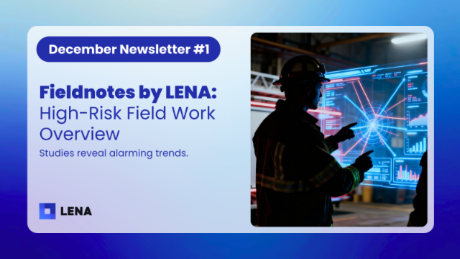
High-risk field work hides risks that often go unnoticed. Small mistakes in fire safety inspections or medical device maintenance can quickly turn into costly delays, repeated visits, or even preventable incidents. Equipment failures continue to resurface, while regulatory and cybersecurity demands persistently grow.
Behind the scenes of high-risk field work
Field teams operate under pressure, and small missteps can have outsized consequences.
- Fire safety — technicians go back and forth between complex inspections across multiple sites, track a wide variety of equipment, and respond to urgent incidents, often with incomplete information or outdated records.
- Oil & gas / energy — technicians work on rigs, pipelines, and substations where mistakes can cause environmental disasters, safety hazards, or major downtime.
- Utilities / power & water — field teams handle electrical grids, water treatment plants, or gas distribution. High-voltage work, confined spaces, and infrastructure failures pose serious risks.
- Construction & civil engineering — inspectors and maintenance crews work at heights, in heavy traffic zones, or with structural equipment.
- Chemical & manufacturing plants — maintenance staff manage hazardous substances and complex machinery.
- Transportation & logistics — fleet and railway maintenance teams operate under tight schedules and high safety requirements.
- Telecommunications & utilities infrastructure — technicians climb towers, enter confined spaces, or handle live circuits.
Miscommunication between the field and office can delay critical fixes, while manual documentation slows down operations and increases compliance risks. Onboarding new technicians quickly without compromising quality is a constant challenge, especially across distributed locations.
Across these high-risk sectors, common threads emerge: inefficient processes, lack of real-time visibility, slow response times, and high exposure to human error. Without smart systems in place, organisations remain fragile, even when teams are skilled and dedicated.
Why digitising high-risk field operations is the answer
Real-time tracking and smarter decisions. Field teams can track every piece of equipment through QR codes or mobile scans, giving managers instant visibility. When a fault is reported, teams see the full history of the asset, reducing guesswork and improving first-time fixes.
Streamlined inspections and compliance. Maintenance and inspection forms move from paper to digital, letting technicians complete preventive checks or calibrations directly on mobile devices. Compliance checks happen automatically against relevant standards, ensuring nothing gets missed and every action is recorded.
Safer workflows and verified competence. Only certified, compliant technicians are dispatched to high-risk jobs. Training records, certifications, and licence expirations are tracked in real time, reducing the chance of noncompliance and keeping teams safer.
Efficiency and fewer mistakes. Manual workflows slow teams down and introduce errors. Digital systems standardise processes, cut down paperwork, and let technicians focus on preventive work rather than hunting for documents.
Predictive insights and proactive maintenance. Sensors and telemetry feed data into predictive systems, flagging equipment that may fail before it breaks. Moving from reactive repairs to proactive maintenance saves costs, prevents downtime, and reduces risks.
Can AI help in high-risk industries?
AI is no longer just a word thrown around in risky field work. It’s becoming a frontline force for safety and reliability. In energy grids, AI-driven predictive systems detect equipment anomalies before failures occur, enabling teams to pre-position crews and prevent potentially hazardous outages.
Utility management. Schneider Electric highlights that the real transformation comes from shifting from routine, time-based maintenance to AI-powered predictive maintenance. Instead of relying on outdated schedules or incomplete records, utilities are now using connected sensors, machine-learning models, and real-time monitoring to detect abnormal behaviour long before failure occurs.
Wildfire detection. Germany unveiled an AI-enabled autonomous drone designed to detect and monitor wildfires faster than any human team could respond. Solar-powered gas sensors attached to trees pick up smouldering fires within minutes; once a sensor detects an anomaly, it triggers the drone, which flies autonomously to the exact coordinates and delivers real-time infrared and optical footage straight to firefighters.
Rail safety. The Danapur division of East Central Railway launched an AI-powered maintenance and safety system that detects issues often invisible to the human eye, helping teams identify fire hazards, malfunctioning components, and other risk factors before they trigger delays or accidents. Built in-house, the model analyses sensor data, patterns, and anomalies across air-conditioning units, fire-safety systems, hot axles, brake binding, and alarm chain pulling events.
40% of power and utilities control rooms will use AI operators by 2027
Gartner’s 2025 CIO and Technology Executive Survey shows that 94% of power and utility CIOs plan to increase their AI investments this year, with an average spending jump of 38.3%. The shift is driven by a simple reality: human error remains one of the biggest contributors to industrial incidents, especially in control rooms where decisions impact grid stability, safety, and uptime.
By 2027, Gartner predicts that nearly half of power and utilities will deploy AI-driven operators to manage real-time monitoring, predictive maintenance, and anomaly detection. AI systems offer precision, repeatability, and consistency, but they also introduce new cyber-physical security risks. As AI takes on more operational authority, utilities must strengthen governance, access control, and security frameworks to keep systems resilient.
LENA’S TAKE
High-risk field work often looks routine from the outside until small gaps turn into repeat visits, failures, or safety risks. What stood out across all the examples in this issue is how much pressure teams carry when information is incomplete, outdated, or scattered across paper and memory.
Whether it’s fire safety, medical devices, utilities, or transportation, the pattern is the same: complex work running on fragile processes. Digitisation changes that. Field work will always be hands-on and human — but with the right digital backbone, it doesn’t have to be risky. It becomes resilient.
Fieldnotes lands monthly. Subscribe to get the next issue as it publishes.
Subscribe on LinkedIn